



By Anna Sulan Masing (@annasulan), an author, poet and academic who writes about food, drink, identity and colonialism.
Everything is different in Penang.
I spent my early childhood in East Malaysia, then summer holidays visiting my dad there, and annual trips back as an adult. The flavours of the region, of Malaysia, are sunk into my bones and are the brushstroke of home. As someone with indigenous Bornean heritage. I had specific Dayak foods with family, but noodles for breakfast when we went out with dad each morning to the kopitiams, they were my collective identity of being Malaysian. Although dad passed away a few years ago, this breakfast tradition still stays whenever I am back, and it feels ritualised. It is usually a laksa, but I am susceptible to the hot, smoky flavours of a wok fried noodle — a taste that is nearly impossible to get in my now-home of London. This space of breakfast is a public, shared eating place; my private identity is indigenous but my public one is noodles.
I have been to Penang a few times, and it seems appropriate that my experiences are punctuated and framed through noodles, and (mostly) breakfast.
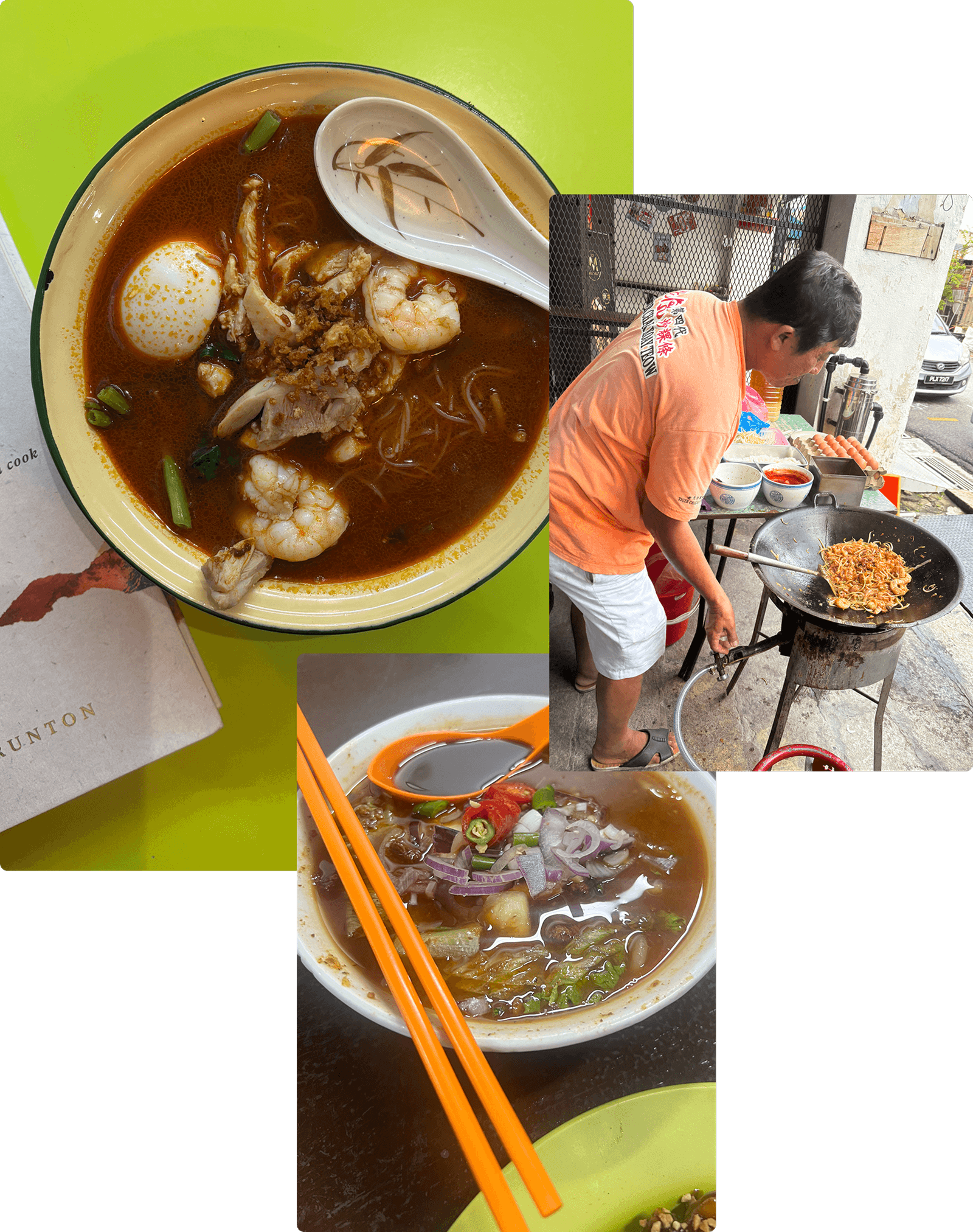
These are three noodle dishes that claim a place in my heart that go beyond trips to the island, are part of my sense of home, are layered into my idea of nostalgia, and memories of belonging. Each of these dishes tell stories of migrants, they weave narratives of communities and identities together to create new homes and new identities. They are the creative work of finding home and community.
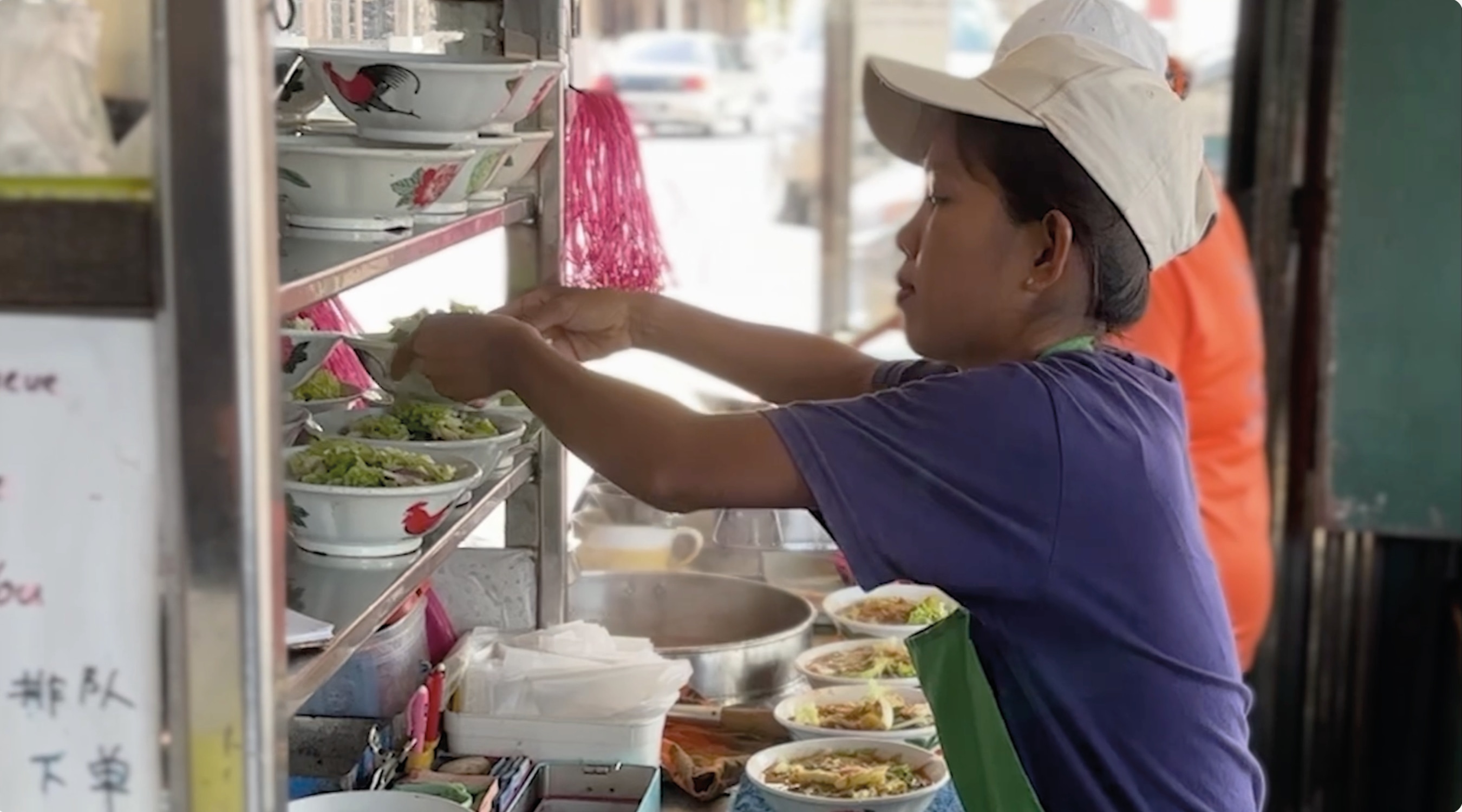
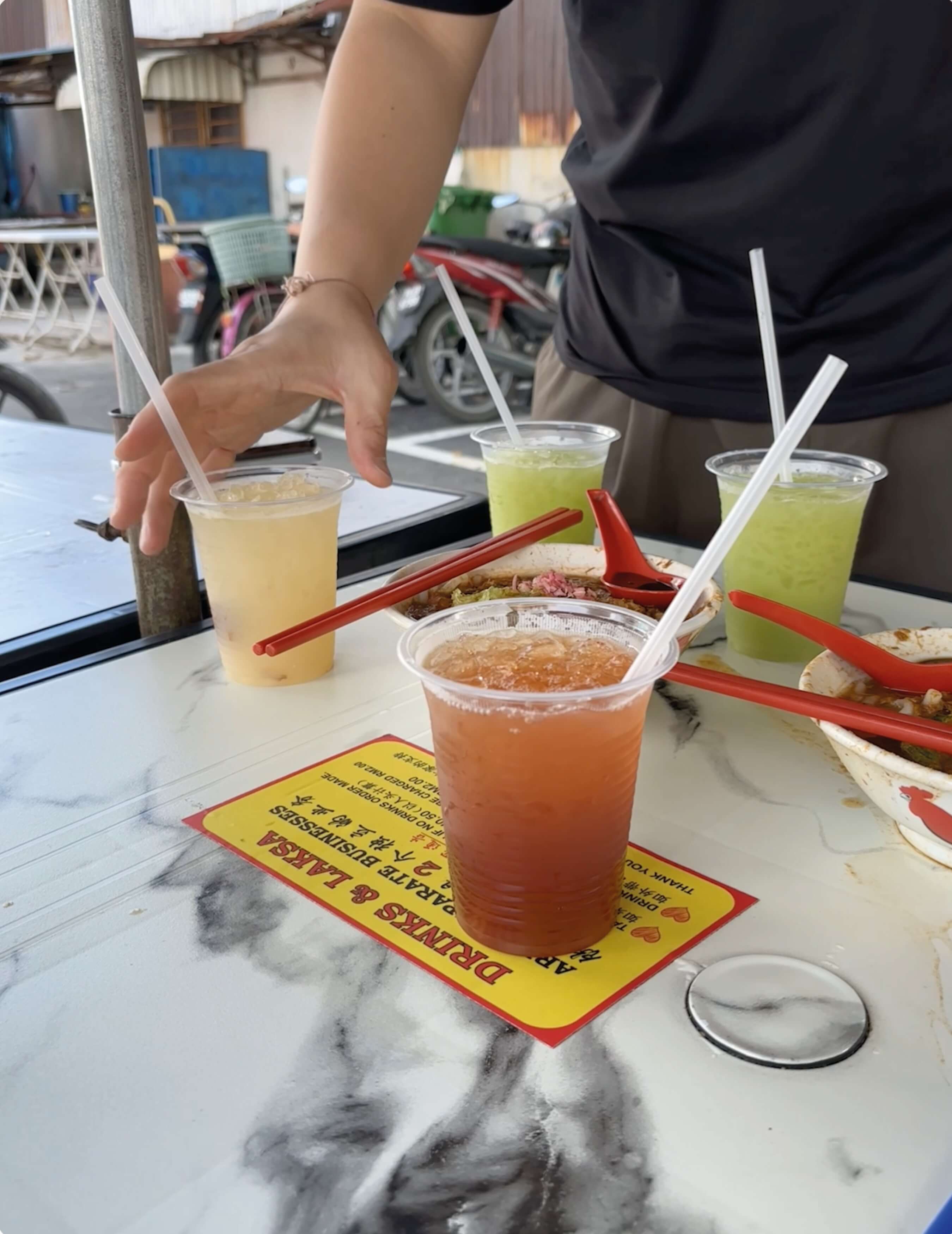
The last time I was in Penang I ate assam laksa for breakfast at a roadside cafe on the other side of the island from George Town, at a busy intersection, beside a carpark. We drank nutmeg juice, which gives hints of cola, a refreshing drink for the building morning heat; trays of nutmeg - the nut, the flesh and the mace - were drying in the sun. The laksa was a deep red-brown, fading to orange at the edges where the liquid wasn’t thickened with mackerel, and the dish was adorned with pink pickled ginger. The rice noodles were thick, slippery and hoarded the flavour as you sucked them up. Assam laksa is a sour, fishy, tangy bowl of comforting spice; I think it is sweet, balancing out the richness of the fish. It is a dish with tamarind, lime, shrimp paste, lemongrass, and minced mackerel. It is the only laksa in Malaysia that doesn’t use coconut milk.
Laksa is a dish that showcases the trade history of the region, and is a quintessential Chinese Peranakan dish. ‘Anak’ means child of in Malay, and Peranakan refers to the descendants of men who came to the region as traders or workers and married into local communities. The term is most often used in regards to Chinese Peranakan, a community that incorporated local flavours, with Chinese cooking styles and cultural traditions. Migration of male Chinese traders to this region of South East Asia dates back to at least the 13th century, although the development of the Chinese Peranakan communities is considered to be mostly related to a larger migration in early to mid-19th century. Chinese women migrated with their husbands in the late 19th century, creating distinct Chinese communities alongside local Peranakan and other migrant communities.
In Penang, the Peranakan identity is particularly steeped in Malay and Hokkien cultures, but being an island, it has a rich, diverse history of multiple migrant groups, as well as nearby cultures, and so the Chinese Peranakan food also blends the likes of Thai influences and South Asian flavours. Laksa - whether it is the Penang assam laksa, or the various coconut based versions - showcases the confluence of the different people that travelled, traded and stayed in the region, a ‘melting pot’ of deliciousness. Laksa is a unique dish in that it both represents a Malaysian identity - as we know Malaysia now, as a country with borders - and a hyper-regional dish that is incredibly varied in each city, town, village, suburb. It is a dish that takes on its immediate cultural influences to demonstrate the specificity of the Peranakan identity. It is easy to connect laksa with Malaysian-ness, but it is important to understand that it is from specific Peranakan communities.
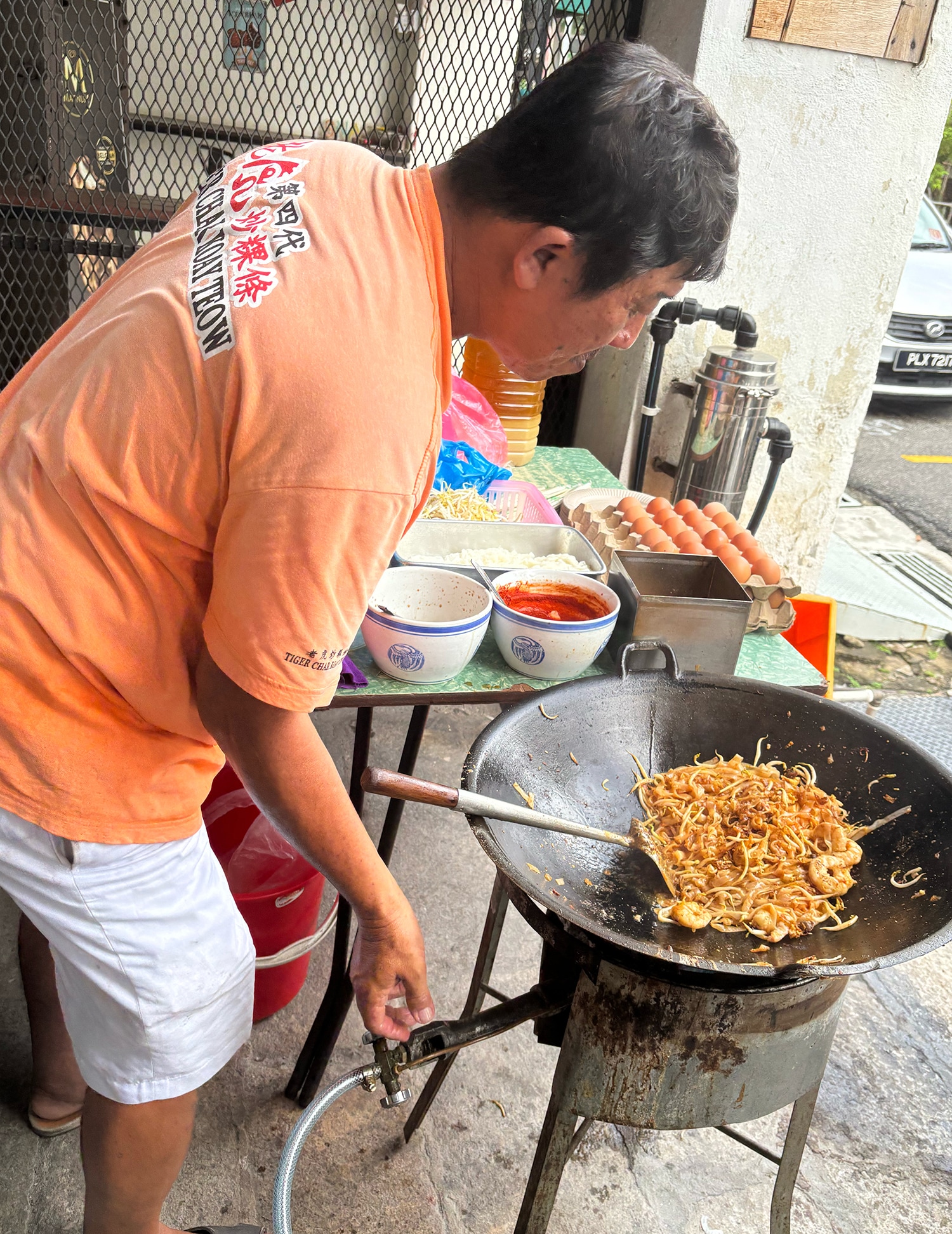
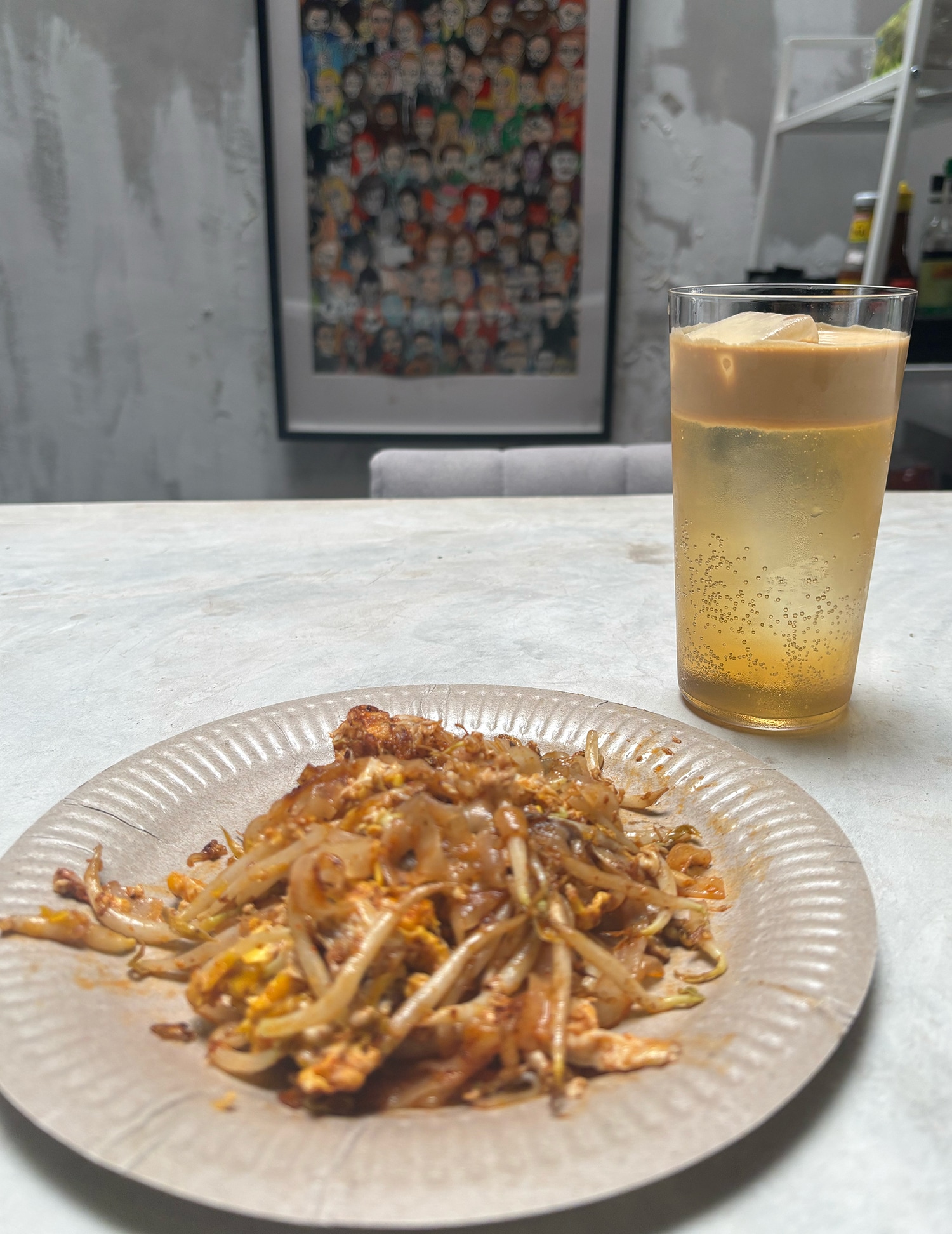
This stir-fried, flat rice noodle dish is a whispered legend around London. Every Malaysian or Singaporean relays the best place to get this dish in the capital, the point being no one can really capture it and so the conversations are about the closest approximation - Sudu in Queen’s Park I think has something worth gossiping about. I remember this dish as something my father ordered at the kopitiam around the corner of our house; it was a nice version of the dish, and it didn’t matter that it wasn’t the best because it still had the essence. The key is the hot, hot smoky wok, an impossibility unless you have an outside kitchen and the ability for an open flame. And, the dish needs to be served piping hot.
the dish is made from cockles, Chinese sausage, shrimp paste, prawns and each vendors’ personal twist to the ingredients. its heritage is both Hokkien and Teochew, from those who came to the region from the South East coast of China in the late 19th century, but it is wholly a Malaysian and Singaporean dish. Throughout the region it has various spellings, reflecting the different groups of migrant communities.
The idea of a dish or food having a clear lineage, or place of original belonging is a bit of a fallacy, because people move in non-linear ways, there are fluxes and communities and regions are not homogeneous; the influence of local ingredients, needs of communities, the coming together of different cultures, all adds to the development of a dish and makes a dish’s history complex, murky, interesting, and never a definitive story. This dish has a particularly special place in Penang’s culture, linked to the place because of the strong Hokkien community, and most Malaysians recognise this - we’ll admit that the best version is found in Penang. Which vendor in the city is the best, that is always up for debate!
For me, food is always about people and circumstances. The best plate? Char Koay Teow being cooked by Tiger Char Koay Teow, outside the café Small Plates by special request. Served up smoking hot, on paper plates, balancing the dish alongside a tequila and coffee cocktail, whilst I stood outside speaking to an amazing group of photographers, writers, bartenders, bar-owners, from all over South East Asia. The heat of the sun, the smoke off the wok, the cool drink that gave me a buzz; it was enlivening my senses. Then three days later, I met my high school friend Liz, who had flown into Penang to see me, at breakfast - a small, busy, kopitiam on a chaotic crossroad. I lined up at a stall, where an uncle in blue shorts and a worn t-shirt had a large notebook on two stacks of cooler bins to form a table, taking orders for the dish. The line was long, the wait for food was longer, and the efficiency, crowd control, and slick service of the uncle mirrored a Maître d' at a high end French restaurant. We shared the dish, drank up our kopi’s and talked about the next place to eat - breakfast, part two. These moments, and eating the dish with my dad - the three best places in Malaysia to Char Kway Teow.
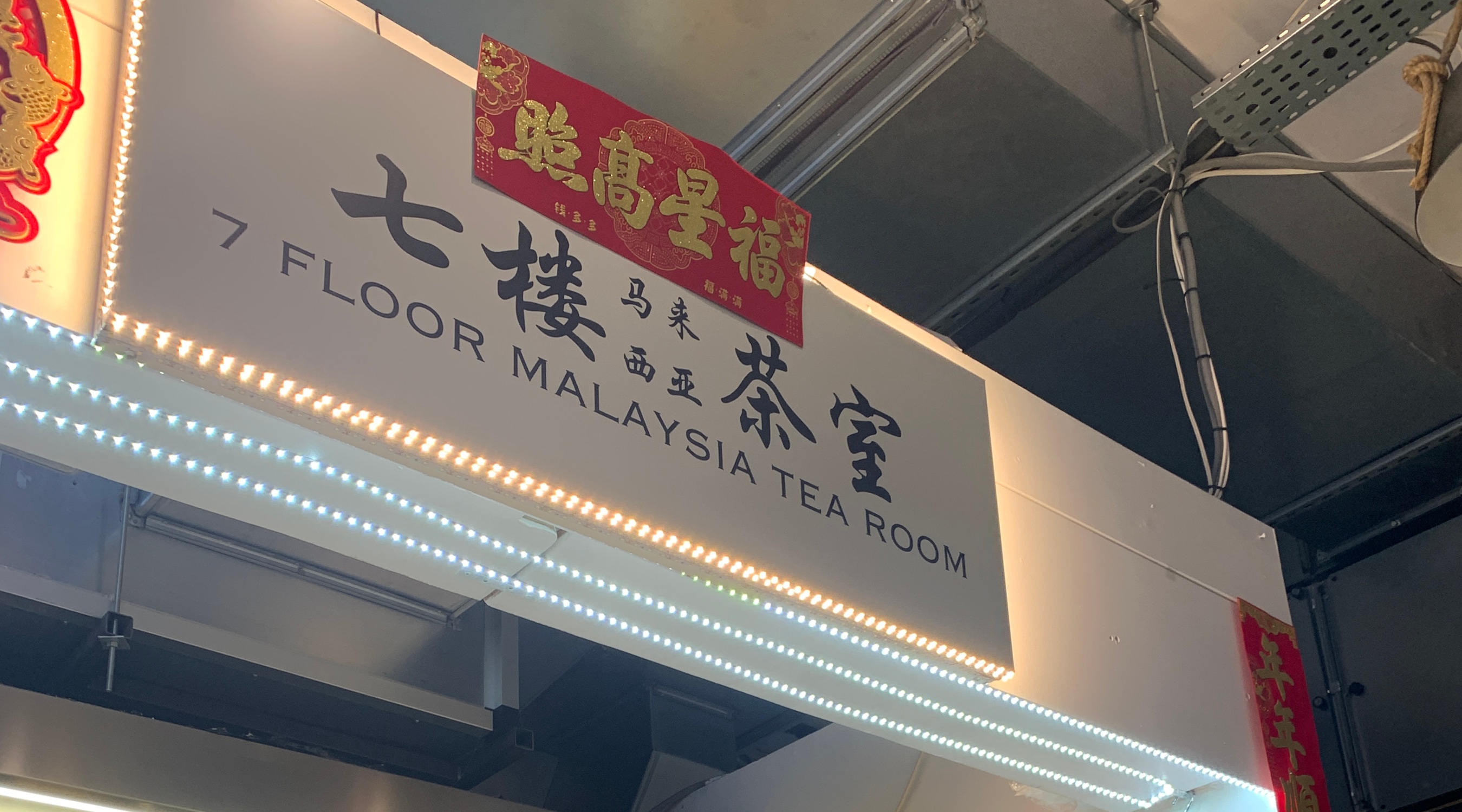
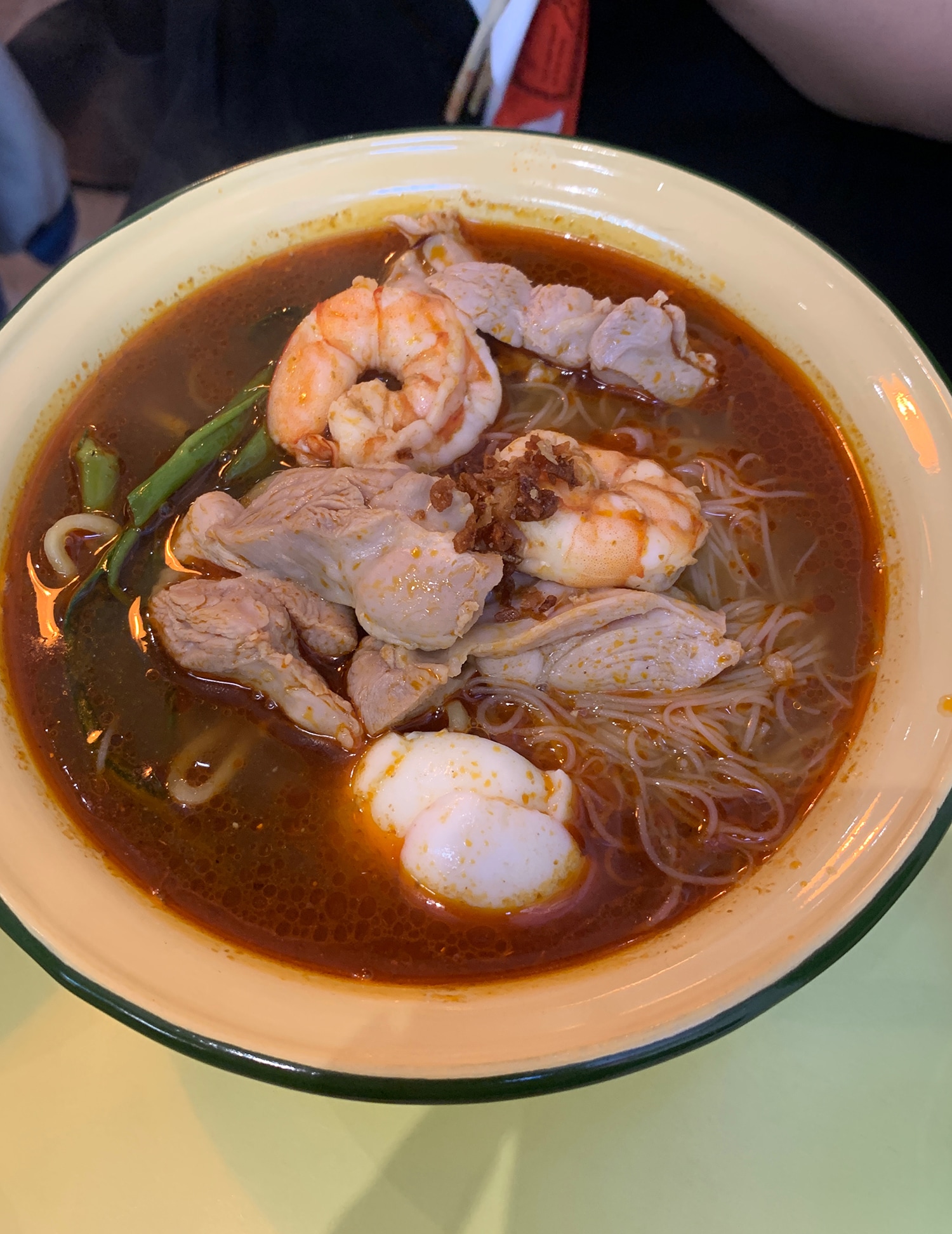
The first time I ate Penang Hokkien Mee I didn’t realise what it was. I was told that there was a Penang Malaysian spot in central London that made great assam laksa and prawn mee. So I had to go. I went for the laksa, but decided to try the ‘prawn mee’. It was the best noodle dish I have ever eaten. ‘7th Floor Malaysian Tea House’, which is neither on the 7th floor, nor a tea house, is one of three vendors in a small shop front in Holborn, and only open until 8pm. My siblings and I went one early evening to celebrate Gawai, the Dayak harvest festival. When you’re away from home you don’t need to eat the exact dishes from home, the fact it was ‘Malaysian’ was enough.
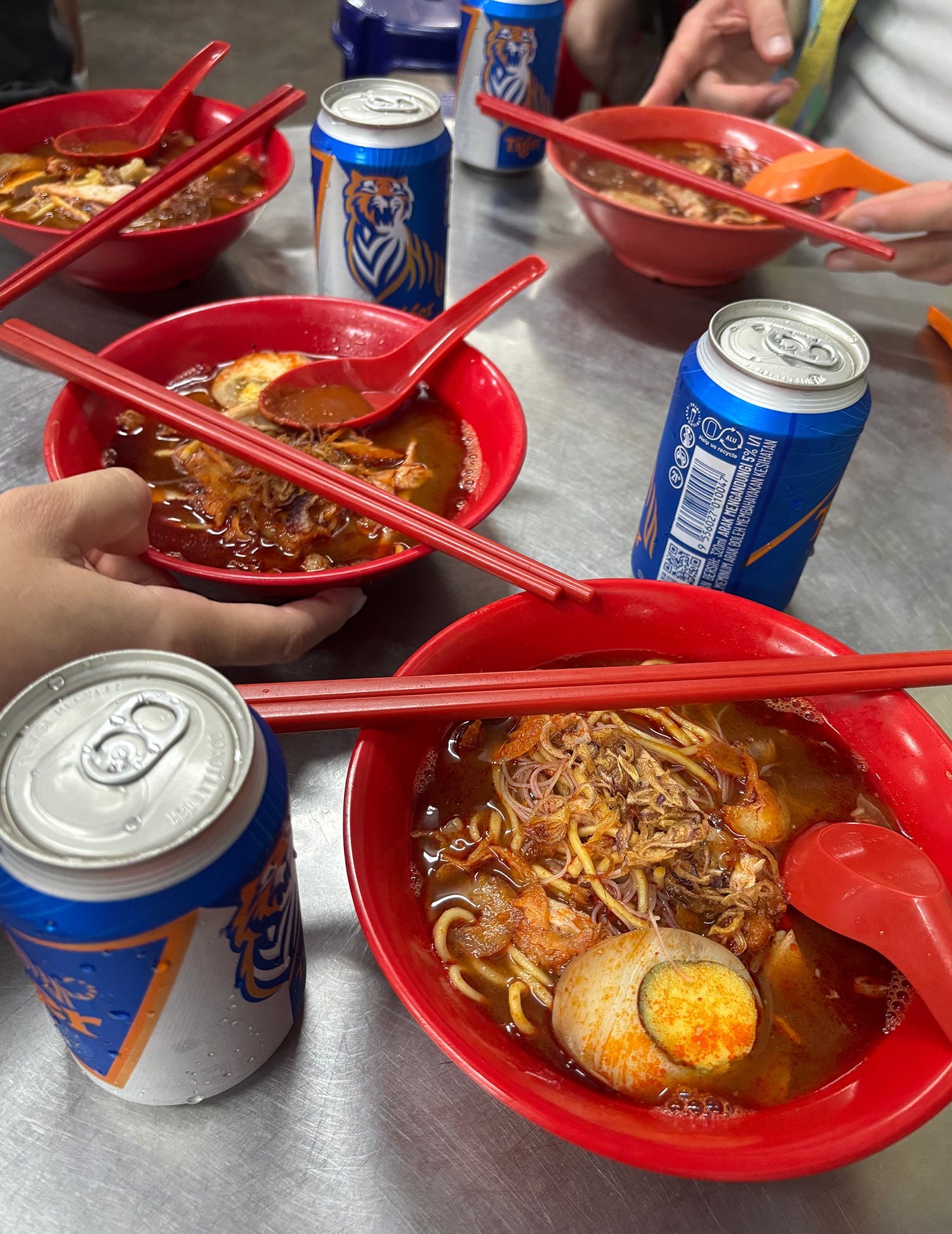
When I went to Penang last September and was told to eat Hokkien Mee I assumed people meant the Hokkien Mee that I have in Kuching - a dry, stir fried, deeply smoky, rounded egg noodle dish. I realised it was ‘prawn mee’ and became slightly obsessed at googling the places I needed to eat it at. The kopitiam near my hotel, I was never early enough for; the vendor shaking his head and packing up “too late, too late!”. It wasn’t until the last day with Liz, that I got there in time. But the best bowl was unexpected: an early evening bar crawl (No Bar Here, Suckling Pig, Chez Chez) and a desperate look around to find something to eat before continuing - up ahead was an intersection with stalls. One stall was selling Hokkien Mee and when we got in line, we could see the dwindling supply. We took the last few bowls, shuffled and squeezed on to a round stainless steel table, ordered cans of beer and inhaled the deep, vivid red bowl of noodles. Sweat dripping down my chest, cold beer sips between mouthfuls. A mix of thin egg noodles and vermicelli, with half an egg, kangkong (water spinach), crispy onions and littered with prawns. It was umami heaven, with the rich prawn head broth, and red chillies for kick and colour. We were all full of laughter, loud, joyful, telling stories with vigour that I have no recollection of.
I have since found out that the stall, 888 Hokkien Mee, is renowned. It is run by Goh Poh Kim who is in her 70s and was opened in 1991; it opens at 3pm and shuts when sold out - about 8pm, from our experience. Her recipe was passed down through the family, with Goh receiving it from her sister-in-law. It is only in Penang that Hokkien Mee is a noodle soup dish, and it is tricky to find out its origins. It comes, unsurprisingly, from the Hokkien community and likely from those that came to the area from the late 19th / early 20th century. Hokkien Mee resembles a Xiamen dish, but with belacan, the shrimp paste of South East Asia. It is a dish that is singularly of a place (Penang), with a specific, named, relationship to a community (the Penang Hokkien) - created because of people and place. That meal in Penang has found its way on my Instagram page multiple times, I find I want to keep talking about it; and I try to find ways that I can divert trips into central London past Holborn and into 7th Floor Malaysian Tea House. Penang Hokkien Mee is my Roman Empire, I think of it at least once a week.
%202.png)

Lorem ipsum dolor sit amet, consectetur adipiscing elit. Suspendisse varius enim in eros elementum tristique. Duis cursus, mi quis viverra ornare, eros dolor interdum nulla, ut commodo diam libero vitae erat. Aenean faucibus nibh et justo cursus id rutrum lorem imperdiet. Nunc ut sem vitae risus tristique posuere.